










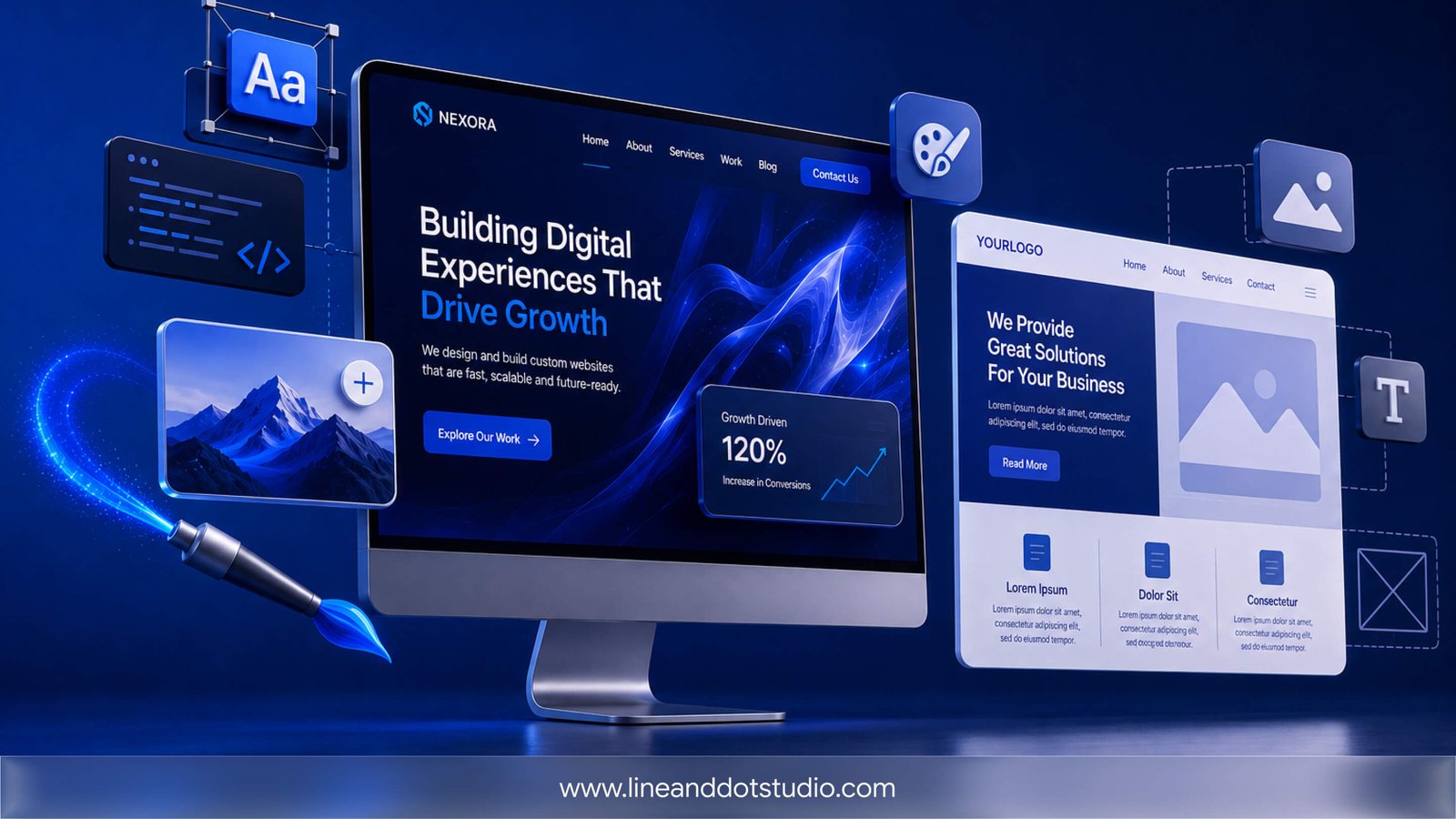
Choosing how to build your website is one of those decisions that feels straightforward right up until you are the person who has to make it. On the surface, it reads as a simple cost comparison: a template you could launch this month for a little more than the price of a subscription, or a custom build that asks for a larger budget and a longer wait before anything goes live. Underneath, it is a decision about the next few years of your business. It is about how you want to be perceived, how you intend to grow, and how much of your time and money you are prepared to spend maintaining whatever you choose today.
That is why the familiar framing of custom website versus template, treated as a contest with a single winner, tends to lead people in the wrong direction. Neither option is better in the abstract. One of them is better for the business you are actually running, and the purpose of this guide is to help you recognise which, and to put your budget where it genuinely earns its place. Get that match right and either path can serve you beautifully. Get it wrong and you tend to pay for it twice, once to build and again to rebuild.
Website builder, template, or a custom website?
A great deal of the confusion in this debate comes from treating a website builder and a template as the same option. They are not, and the difference shapes what you are able to do long after launch.
- A website builder, such as Wix, Squarespace, or Shopify, is an all-in-one platform you effectively rent. Design, hosting, and editing live together in a single dashboard, which makes it the fastest way to get online and the easiest to manage without a developer.
- A template or theme, a WordPress or Webflow theme for example, is a pre-built design you install on a platform you control. You inherit a considerable head start on the visual design, but you own the setup, and you can change far more of it when the need arises.
- A custom website is designed and built around your specific goals from an empty page. Nothing is inherited. Every decision, from the layout to the way a booking moves from first interest to confirmation, is made deliberately for your business.
It helps to picture these as points along a spectrum of control rather than three boxes to tick. Most real projects settle somewhere in the middle, and the most successful ones are deliberate about exactly where they sit on that line.
Custom website vs template: what actually decides it
Because price is the easiest thing to compare, it tends to dominate the conversation and win arguments it has no business winning. A far more reliable approach is to ask where your website does the real work of your business, and then to spend where that answer points. Four factors decide this question more dependably than budget ever could.
- Differentiation. How much of your advantage lives in the experience of the site itself? A design studio whose brand is effectively the product needs a level of control that a local plumber, who mainly needs to be found and called, simply does not.
- Bespoke behaviour. Bookings, quote calculators, member logins, live inventory, integrations with your CRM or scheduling tools. The more of these you need working together, the sooner a template begins to strain against its limits.
- Content velocity. If you publish regularly, structure and speed begin to compound in your favour. A fast, well-organised site turns content into rankings over time, while a slow and rigid one buries the very same work.
- Ownership after launch. Once the site is live, someone has to run it. A builder hands that responsibility comfortably to a non-technical team, whereas a custom site usually relies on a partner for anything structural.
The question worth sitting with
The useful question is not "which option is cheaper," but "where does my website actually do the work?" Write down the specific moments where a visitor books, buys, signs up, or decides to trust you, and direct your budget towards those moments. For everything else, a template is often invisible to the customer, and that is precisely the outcome you want.
Template vs custom website: how they compare
| What you are weighing | Template or builder | Custom build |
|---|---|---|
| Upfront cost | Low: a subscription or a one-off theme price. | Higher: you are paying for strategy, design, and build time. |
| Cost across three years | Rises steadily with plugins, apps, and the hours spent working around limits. | Front-loaded, then largely hosting and small refinements. |
| Time to launch | Days to a few weeks. | A few weeks to a few months. |
| Distinctiveness | You share a layout with everyone else who bought it. | Built around your brand and your customer's journey. |
| Performance ceiling | Capped by the theme and its page-builder markup. | You control speed, structure, and Core Web Vitals. |
| Bespoke features | Possible through plugins, until they conflict or reach a wall. | Built in from the outset and made to fit. |
| Ownership and lock-in | Builders are difficult to leave; themes keep your content portable. | You own the code and can move it wherever you like. |
| Maintenance | You, inside the platform's dashboard. | You for content, a partner for anything structural. |
Read across that table, and a pattern emerges: templates tend to win the first year, and custom tends to win in the long run. Which of those years matters more to you depends entirely on your plans, which is rather the whole point of the exercise.
Whether template or custom, every website answers to the same test
Here is the part that both sides of the argument tend to forget. A custom site and a template are simply two routes to the same destination, and that destination is not "how bespoke does it look." It is whether a user understands you quickly enough to stay.
Two long-standing principles capture the standard well. The first comes from Steve Krug, who argued that a page should be self-evident, so that a visitor never has to stop and puzzle out what something is or where to click. The second is Donald Miller's grunt test, which states that, within roughly five seconds of arriving, a visitor should be able to say what you offer, how it will improve their life, and what to do next. Both point to the same fact: people form a judgement about your credibility in the first fraction of a second, and that first impression colours everything they read afterwards.
A template that passes both tests will out-earn a custom site that fails them, and the reverse holds just as firmly. So it is worth running that test on your current site before you spend anything on either path. If it already passes, custom becomes an upgrade rather than a rescue. If it fails, find out why before you rebuild, because a more beautiful version of a confusing message only fails more expensively.
Do website templates impact SEO?
This is the fear that pushes most people towards a custom build, and it rests largely on a misunderstanding that is worth clearing up, particularly if your current site is not ranking the way you had hoped.
Google ranks pages, not the tool that produced them. There is no penalty for using a template, a builder, or WordPress, and Google's own guidance is consistent on this point: content quality, site structure, and a genuinely good page experience are what count. A clean template on fast hosting can absolutely rank.
Where templates lose ground is weight. Many themes ship with visual page builders that generate heavy, deeply nested markup to make drag-and-drop editing possible, and that extra code slows the page down. Page speed is measured, and Google's Core Web Vitals set the bar clearly: a largest contentful paint within 2.5 seconds, an interaction to next paint under 200 milliseconds, and almost no unexpected layout shift. Interaction to Next Paint, which replaced First Input Delay in March 2024, measures how responsive a page feels the moment someone taps or clicks, and bloated builder markup is exactly what tends to struggle there.
So the real question was never "custom or template." It is a set of sharper questions:
- Does the page load quickly and stay responsive, or does the theme weigh it down?
- Can you control your headings, titles, and structured data, or does the template hold them out of reach?
- Is your content genuinely useful, or does it repeat what a hundred other pages already say?
That final question matters more than the platform ever will. Google's guidance rewards content that is genuinely helpful and original, and it discounts pages that merely restate what is already widely published. A template can carry brilliant, distinctive writing, and a custom build can just as easily hide thin, familiar pages. The build sets your performance ceiling; your content decides whether you ever reach it. A lean template with excellent content will outrank a bloated custom site every time, and a custom build helps only because it removes the ceiling, not because "custom" is a ranking signal in itself.
If your existing site is slow, thin, or fighting against its own theme, that is usually where your rankings are leaking, and it is fixable on either path. For a closer look at where performance work actually pays back, our guide to what a B2B SaaS website redesign costs walks through the return in detail.
The recurring costs a website template's price never shows you
The upfront saving on a template is real, and it deserves to be acknowledged. The recurring cost is the part most people forget to add up, and across a few years it can close much of the gap with a custom build.
It arrives as plugin and app subscriptions that stack up month after month, as premium page-builder licences, and, above all, as the hours someone spends persuading the theme to do something it was never designed to do. Every "could we just move this button and connect it to our booking system" becomes a small project of its own. Beyond that sits the ceiling: the moment your business outgrows what the template will allow, when the inexpensive beginning turns into an expensive rebuild.
None of this makes a template the wrong choice. It simply means that "cheap" is a figure you should measure across three years rather than three weeks. That total-cost-of-ownership view is the same lens we bring to any website design project, and it is the single most useful way to weigh this particular decision.
Can you start with a template and switch to custom later?
Yes, and it is often the wiser sequence. You launch lean, you learn what your customers actually do, and then you invest in custom work where the evidence points rather than where you had guessed. Starting modestly is not a mistake; it is a sensible way to buy information before you commit to a build.
The one thing to watch closely is lock-in. If you begin on a builder such as Wix or Squarespace, "going custom later" usually means a full rebuild, because those platforms do not export cleanly into anything else. If you begin with a template on WordPress or Webflow, your content, your URLs, and much of your hard-won SEO equity travel with you. So if you already suspect you will need custom within a year, the platform you choose today has already settled the question of whether "later" costs you once or twice.
Custom website or template: how to invest wisely
Overpaying is not only a risk on the custom side of the ledger. Both directions have a way of costing more than they should, simply in different currencies.
- Overspending on custom means paying for bespoke craft on pages and moments no customer will ever notice. A hand-built "about" page rarely earns its cost. There is little sense in paying for craftsmanship in precisely the places where a template would have been invisible.
- Overspending on a template shows up later, as the inexpensive site that costs you enquiries because it loads slowly, buries the one action you need, or looks unmistakably like a competitor's. Every visitor arrives with a small reserve of goodwill, and each of those frictions draws it down. Empty that reserve and they leave, and the bill for it arrives as revenue you never see.
- The rule that holds up: buy custom where your site touches money or memory, the checkout, the booking, the moment your brand is meant to be remembered, and use a template for everything else. Most good websites are a considered hybrid, and that is a strength rather than a compromise.
If you are trying to locate where those money-and-memory moments actually live, our piece on landing page vs homepage makes a useful companion, because it applies the same instinct one level further down.
Not sure which moments on your site deserve a custom touch and which do not? That is precisely the audit we begin with.
A template does not rank you, and neither does a custom build. Clear content on a fast, well-structured page does. The build itself is simply a question of how much control you want over getting there.
When to choose a custom website, a template, or a hybrid
To make all of this concrete, here is the short guide to recognising yourself in one of the three.
Choose a template or builder when your site's main job is to look credible and explain what you offer, when your timeline is short, when you are testing an idea, or when a non-technical person needs to run it day to day. For a great many good businesses, this is the responsible and correct choice, not a compromise.
Choose a custom build when your website is where the work genuinely happens, when your brand is a real point of difference, when you need features that have to work together, or when you publish often enough that speed and structure decide your visibility. This is an investment, and it should be treated like one.
Choose a hybrid when you are like most businesses: a solid platform, a well-chosen template as the foundation, and custom work concentrated on the two or three moments that actually convert. It is usually the best value of the three. For the fundamentals beneath any of these approaches, our explainer on what web design really is is a good grounding, and a handful of small website UX changes often matter more to your results than the build itself.
Find the right build for where your business actually is
Tell us about your business and your goals, and we will show you exactly where custom pays off and where a template will do the job just as well.
